From routine visit to lifesaving care: a patient’s story

A routine checkup turned lifesaving when testing revealed a dangerous aneurysm. Discover how patient-provider collaboration made the difference.

June 22, 2026 | 8-minute read

In this article

A routine appointment

When Michael Pratt walked into his ProHealth Physicians family medicine office for what he described as “a regular checkup — normal stuff, blood work and whatnot,” he expected nothing more than the familiar pat on the back he’d gotten for years. 

“I’m a 60‑year‑old man. I exercise regularly, I don’t eat junk food, don’t have prediabetes or anything,” he said. “Doctors have always told me, ‘You’re in fantastic shape! I wish my 40‑year‑old patients were as fit as you!’”
An unexpected result

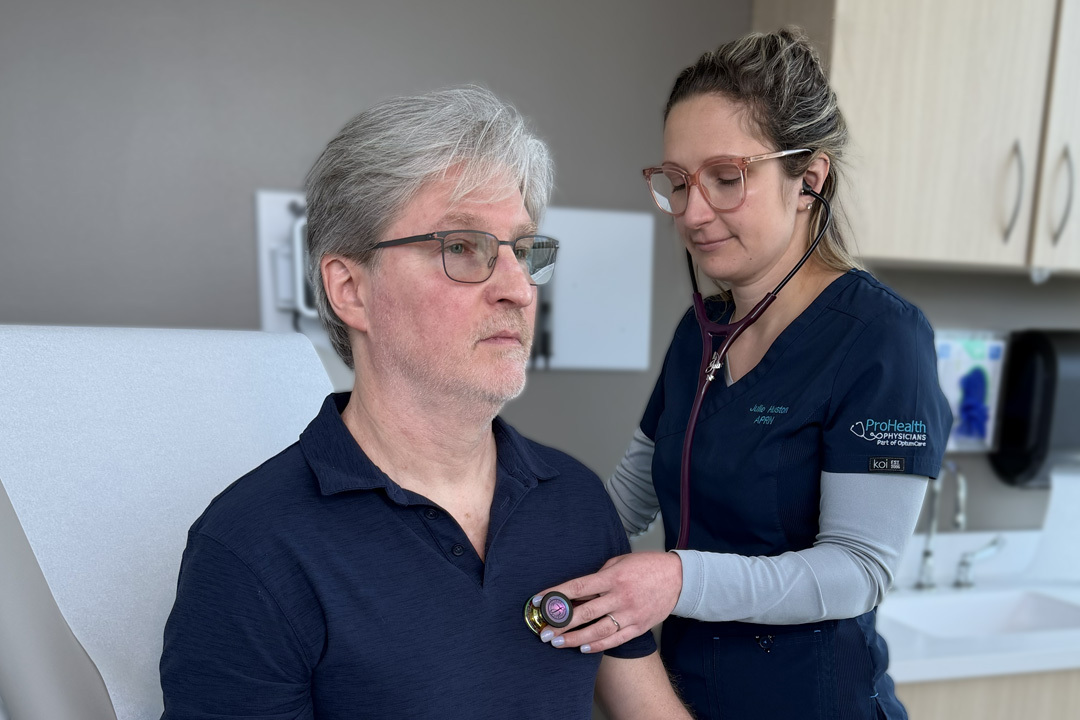
He had been seeing Julie Huston, APRN, for only a short time. His former clinician had moved on, and Julie had stepped in quietly — one of those routine transitions patients make without much thought.

The appointment felt just as routine — until his results landed. His blood pressure and cholesterol were higher than expected. They were common findings, the kind that normally trigger a straightforward plan. “Typically, you go to a doctor, they put you on statins and blood pressure medication, and you move on with your life,” he said.

But Michael didn’t want to “move on” that way. He wanted medication to be the last step, not the first. He’d spent years building healthy habits; he didn’t want to abandon that work if there was still room to understand what was happening beneath the surface.

Meeting patients where they are

Julie didn’t push him. She met him exactly where he stood. “He was hesitant about taking statins,” she says. “He wanted to make sure he’d already moved all his levers — diet, exercise — before going the medication route.”

Instead of insisting, she looked for clarity. She suggested a coronary calcium score. “We don’t know if there is any damage. We need a clearer picture,” she remembers telling him. She explained the test wasn’t covered by insurance, but it was reasonably accessible — and it would give them real answers.

For Michael, that mattered. He didn’t want the easy path; he wanted the right one. Julie understood that. “I can prescribe anything,” she says, “but if patients don’t believe in the reasons for taking the medication, they’re not going to take it. You have to meet patients where they are.”

A shared commitment to getting it right

The scan became their shared next step — not a shortcut, but a commitment to being thorough. As Julie puts it: “The calcium index is very black and white. I knew he didn’t want to start meds, so it was a way for us to determine where he really was—and go from there.”

Michael scheduled the scan for January 15, 2026.

That night, at 6:30 p.m., his phone rang. It was ProHealth’s on‑call clinician. “I knew immediately something strange was going on, because it was late for the doctor to be calling,” he said.

Then came the message that would change everything: “Your arteries are clear, but there was an incidental finding. You have an aortic aneurysm, and I need you to go to the ER tonight.”

Serious complications

The diagnosis: an ascending thoracic aortic aneurysm measuring about 5.0 cm — dangerously enlarged.

His cardiothoracic surgeon, Dr. Jason Zakko, didn’t soften the truth. “He basically told me, ‘Without that scan, your wife would have found you dead on the floor by May or June. No ifs or buts.’” 

A normal aorta in that section measures 2.5 to 3 centimeters. Michael’s had reached 5.2. “He told me he performs surgery when patients reach 4.”

Michael and his wife were stunned. “It’s not something you would have expected — like all of a sudden you go from a regular checkup to realizing you’re probably going to die.”

Recognizing a close call

Julie felt a different kind of shock when she saw the report — the cold, unmistakable realization of how close something catastrophic had come to being missed. 

“He’s a pretty healthy guy, never a smoker, and the guidelines for screening abdominal aneurysms don’t start until age 65 to 75 if you’re a male and a smoker. There is no screening guideline for thoracic aneurysms.”

Because the aneurysm was discovered only by chance, the “what if” stayed with her. “I kept thinking, what would have happened if we had just decided to start the medication and left it at that?”

A positive outcome

In the weeks after surgery, Michael and his wife came back to thank her. “His wife got teary‑eyed,” Julie said. “As much as I’d love to take credit, the credit is mostly on the patient for challenging me to look at the bigger picture. I’m happy he’ll be able to spend more years with his wife.”

Michael sees it differently. “For as long as I am with ProHealth, I have no intention of seeing any other provider,” he said. “What Julie did is remarkable. People complain when they’re unhappy. I want to be the person who expresses gratitude when things go right.”

The importance of patient-provider collaboration

Michael’s story isn’t about a dramatic intervention intentionally pursued. It’s about what happens when clinicians and patients take the time to think together, slow down and look a little deeper. It’s about meeting someone where they are, even when the path that follows is unexpected.

Sometimes the most meaningful saves are the ones no one is looking for.

Related insights

The Quiet Strength of Optum Super Hero & Phlebotomist Merita

The quiet strength of an Optum Super Hero

 Discover the inspiring story of Merita Morena, a ProHealth phlebotomist and Optum Super Hero, whose empathy and care help patients feel safe, supported and understood.

ProHealth Nurses Earn 2025 Sages of Clinical Service Award

Listening, learning and lifting others

Two ProHealth nurses were honored at the 2025 Sages of Clinical Service Award: Mara Fowler, RN, and Joanne Foss, MSN, RN, CMC, CDP.

How Culturally Competent Health Care Helps Build Patient Trust

Healing in her own words

Healing in Her Own Words: How language and culture transformed Doña Ramonita’s care.